













01
Workplace strategy
Occupancy studies, employee surveys and leadership visioning that turn into a clear brief: how much space, what settings, and why.
Workplace strategy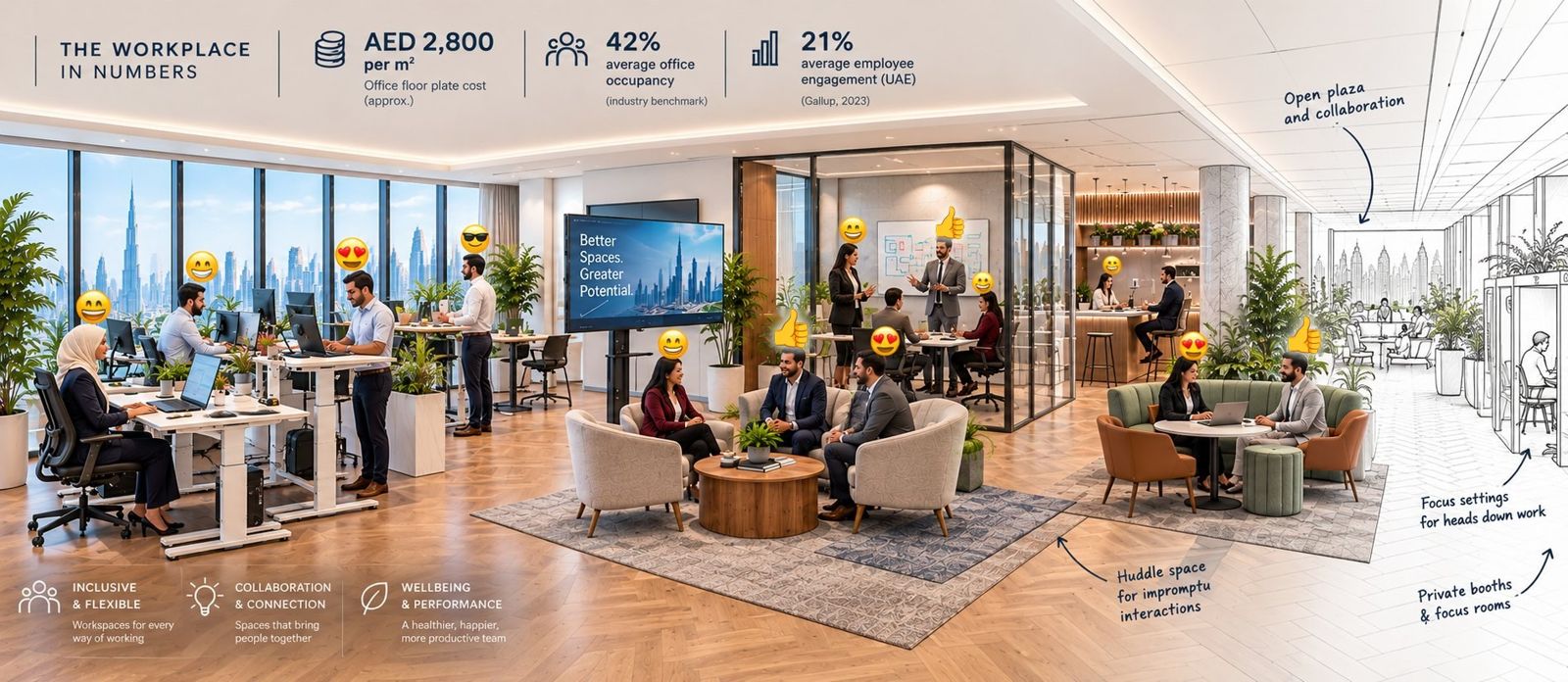
Maven helps Gulf organisations plan, design and move into workplaces their people actually want to use. Data-led, human-centred and built for change, from first brief to post-occupancy review.
How the free pulse survey works
Trusted by
The short answer
Workplace strategy is the process of matching an organisation's office space to how its people work. It uses occupancy data, employee research and business goals to decide how much space you need, what kind, and how it should be used, before a single desk is ordered.
Change management is the other half. It prepares people for the new way of working so the space gets used as intended. Without it, a well-designed office becomes an expensive version of the old one.
The stakes are real. Only 1 in 3 workplace redesign projects achieve high performance (Leesman Index), and 55% of people say they struggle to work effectively in their office (Gensler).
Occupancy studies, employee surveys and leadership visioning that turn into a clear brief: how much space, what settings, and why.
Workplace strategyLeadership coaching, employee workshops and move communications so people arrive ready to work in the new space.
Change managementActivity-based settings mapped onto your floor plan, so every zone supports a real activity: focus, collaboration, social or learning.
Activity-based workingSensor and survey data three to six months after move-in, showing what's working, what isn't, and what to adjust.
Post-occupancy evaluationHow we work
Align leadership on what the workplace must achieve, and hear from employees early.
Visioning workshops · Employee surveys · Focus groups · Hybrid work profiles
Measure how your current space is really used and where it lets people down.
Occupancy sensors · Utilisation studies · Workplace evaluation · Space brief
Lead people through the move and check the results once they're in.
Change leadership · Employee workshops · Move-in support · Post-occupancy evaluation
Case study · ALEC, Dubai
The brief: create an environment that enables focus, improves collaboration, and reflects the scale and ambition of the business.
The result at Marina Plaza is a workplace built around ALEC's people, culture and next phase of growth.
Selected work
From 40-person teams to 3,000-employee headquarters, across the Gulf and beyond.
Swipe the map to see every location
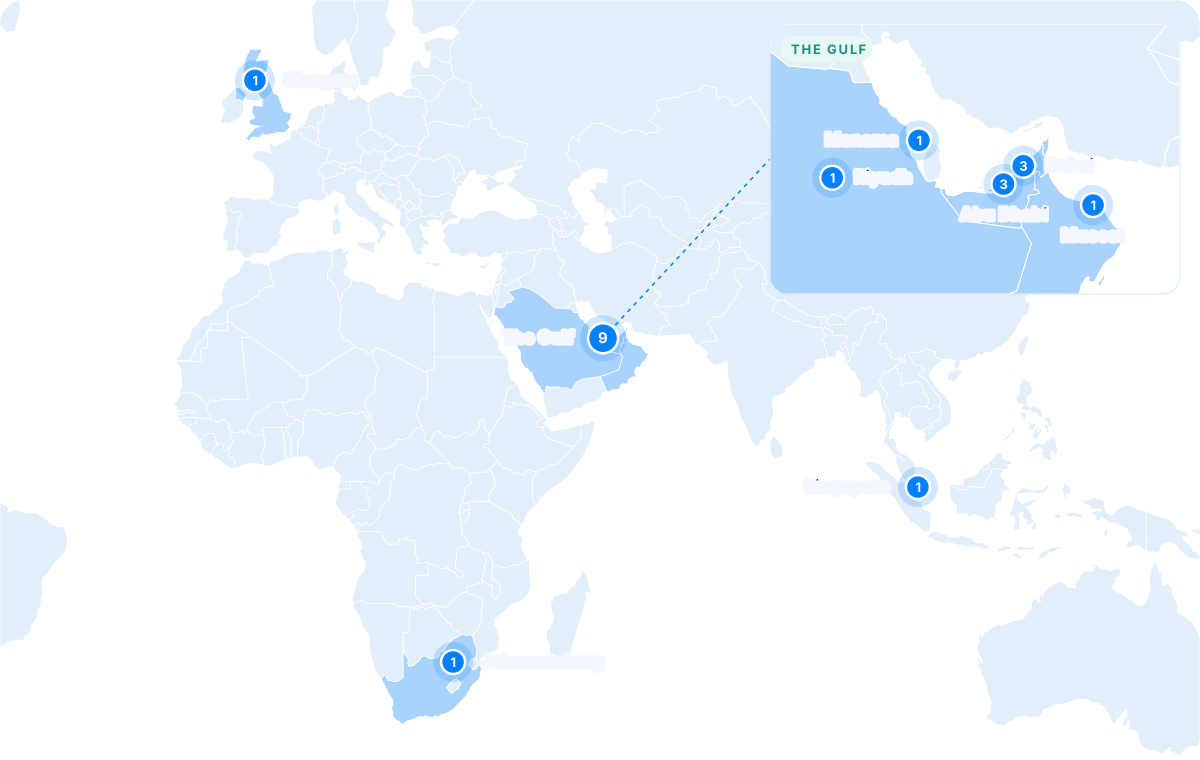
 United Arab Emirates
 Saudi Arabia
 Bahrain
 Oman
 Singapore
 South Africa
 United Kingdom
Knowledge hub
Talk · Future of work
Episode 5 · Hybrid work
Workplace research
1,320 people surveyed in 2025, compared against the 2015 baseline. Inside the report:
Published by Workplaced, October 2025, with Haworth and Savills Middle East.

Founder
Oliver studied Psychology at Sheffield Hallam University, where he also completed his Master's degree in Psychology. He spent his early career in applied psychology across Sheffield, Oslo and London before moving to the Gulf in 2015.
Since then he has advised organisations in finance, tech, media, pharma, healthcare and education on how their offices shape the way people work, and speaks across the region on the future of work, including at TEDx.
Testimonials
“Oliver is an outstanding workplace consultant. His skills in applying design thinking and research to our office redesign led to practical, visually appealing results, driven by the data gathered from user feedback sessions & surveys.”
“Oliver's contributions were truly significant to setting the foundation for success of the BP Oman project.”
“Oliver is an outstanding service provider in Workplace Maven. He works towards the success of the client with the best of his knowledge using new tools and methods.”
“His ability to keep everyone interested throughout a whole day session is amazing. There was never a dull moment.”
Keynotes & seminars
Before you sign a lease or brief a designer. Strategy work done early sets the space requirement and saves the most money; brought in after design, it can only fine-tune.
The Prosci ADKAR model: Awareness, Desire, Knowledge, Ability and Reinforcement. We plan the change in 6 to 12 weeks, deliver it alongside fit-out over 5 to 9 months, then reinforce it for at least 3 to 4 months after move-in.
Designers decide how the space looks and is built. We decide what it needs to do, based on data about your people, and help them adapt once it's built. We work alongside your designer. Because we're independent, our recommendations won't always need a redesign.
An office laid out by task rather than by assigned desk: quiet focus zones, collaboration spaces, social areas and places to learn. People choose the setting that fits the work they're doing.
[TYPICAL DURATION, e.g. 6 to 10 weeks for strategy; change management runs through to move-in and beyond.]
Yes. Maven works across the GCC, including Saudi Arabia, the UAE and Oman.
Most Gulf organisations don't know what their workplace is costing them. A 30-minute call changes that. No pitch, just clarity.