Hybrid is no longer the disruption. Disengagement is.
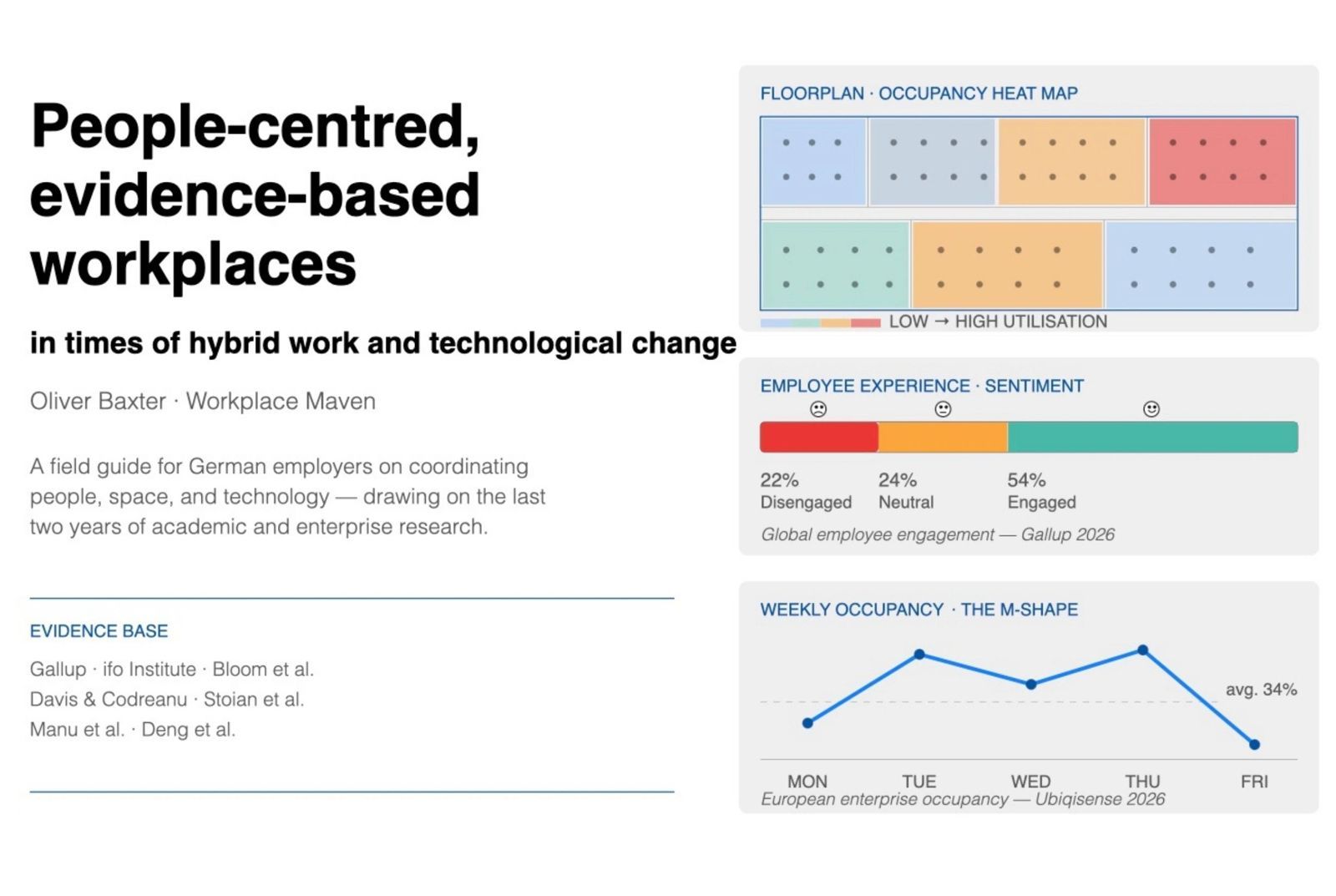
Gallup's 2026 State of the Global Workplace report puts global employee engagement at 20%, its lowest level since 2020, and estimates the cost of disengagement at around US$10 trillion in lost productivity. Manager engagement has fallen from 31% to 22% in three years. Yet many organisations are still running hybrid teams with pre-pandemic buildings, pre-pandemic policies and pre-pandemic assumptions.
I first wrote this piece for the IBA Forum's Perspectives series, aimed at German employers. The evidence travels well. In the Gulf, where return-to-office mandates are common and investment in new office space hasn't slowed, it arguably matters even more.
The hybrid question is largely answered
In Germany, working from home has settled at just under a quarter of all working days, according to the ifo Institute. That isn't a temporary arrangement waiting to unwind. It's the baseline.
The strongest evidence on performance comes from a randomised trial at Trip.com, published in Nature in 2024 by Bloom, Han and Liang. 1,612 graduate employees were split between two home-working days a week and full-time office attendance. The hybrid group showed no loss of productivity, attrition fell by a third, and promotion rates didn't change.
A 2025 cross-country study of 1,255 IT employees and managers (Stoian et al., Sustainability) found a sweet spot of six to ten office days a month. People in that range reported higher perceived efficiency and less office-related stress. The same study found managers were nearly twice as likely as employees to rate hybrid as the most efficient model.
That gap between how leaders and staff experience the same policy is where disengagement starts.
Managers are the bottleneck
The tools for distributed work are here to stay. An analysis of 5.6 million US patent applications (Davis, Bloom and Codreanu, 2026) found that work-from-home technology patents rose by roughly two-thirds within three years of the pandemic and remain about 50% above pre-pandemic levels.
Adoption is a different story. Gallup found that 65% of US employees in AI-using organisations say AI has improved their personal productivity, but only 12% strongly agree it has changed how their organisation works. Employees whose managers actively support AI use are 8.7 times more likely to say it has transformed their work.
Technology only pays off when management practice is built around it. Buying the platform is the easy part.
Four commitments for a people-centred workplace
1. Model before you mandate
Before setting an attendance policy, test the scenarios against measurable trade-offs: space use, commuting, collaboration, retention and productivity. In the Gulf, long commutes and summer heat change the sums considerably, so build them into the model rather than assuming a policy written for one city will work in another. Scenario-modelling platforms such as Workplaced let you test those trade-offs before anything is announced.
2. Make the policy usable on a Tuesday morning
If finding a desk, a meeting room, a parking space or the right equipment is a hassle, people will quietly stay at home. Booking needs to be simple, linked to calendars, and organised around the kinds of work each zone is meant to support. Platforms such as goconut, which combine Activity-Based Working zones with calendar integration, take most of that friction out.
3. Measure, don't assume
Leadership teams tend to overestimate how well their workplace strategy is working, and engagement surveys pick up problems months after they start. Real-time occupancy and environmental sensing spots them much earlier. Ubiqisense, for example, measures occupancy anonymously, so you get the pattern without tracking individuals.
European enterprise data from Ubiqisense (2026) shows average weekly occupancy of 34%, with an M-shaped week: busy Tuesdays and Thursdays, quieter Mondays and Wednesdays, and Fridays well below the rest. Gulf working weeks run differently (Monday to Friday in the UAE, Sunday to Thursday in Saudi Arabia), so your pattern will look different. You won't know what it looks like until you measure it.
4. Treat environmental quality as a reason to come in
A systematic review of 51 studies (Manu et al., 2024, Building and Environment) found that thermal comfort, lighting, acoustics and air quality consistently predict cognitive performance and wellbeing. A separate review (Deng, Lau and Wargocki, 2024, Indoor Air) showed these factors interact with one another, which single-factor studies miss.
The office now competes with the home. In a region where buildings run on air conditioning for most of the year, thermal comfort and air quality are front-line issues, not background ones.
Three things to do next
- Plan office days around how teams actually depend on each other, not around headcount targets. Anchor days should exist because people need to be in the same room for a reason.
- Measure the building and the workforce together. Occupancy data describes a building. Engagement data describes a mood. You need both to understand a workplace.
- Train managers to support hybrid working rather than police it. Manager engagement is the variable that moves everything else.
The organisations that pull ahead from here will run their workplace the way they run a production system: instrumented, measured and managed by capable people.
This article is adapted from "The Evidence-Based Workplace: Designing for People in an Age of Hybrid and AI", first published by the IBA Forum in May 2026. Read the original with full references.
Sources
- Gallup (2026). State of the Global Workplace.
- ifo Institute (2025). Working from home in Germany.
- Bloom, N., Han, R. and Liang, J. (2024). Hybrid working from home improves retention without damaging performance. Nature.
- Stoian, et al. (2025). Sustainability.
- Davis, S. J., Bloom, N. and Codreanu, M. (2026). Work-from-home technology patents.
- Ubiqisense (2026). European enterprise occupancy data.
- Manu, et al. (2024). Building and Environment.
- Deng, Lau and Wargocki (2024). Indoor Air.